

Powering the Volt Revolution: Global Automotive DC-DC Converter Market to Surpass USD 106 Billion by 2035
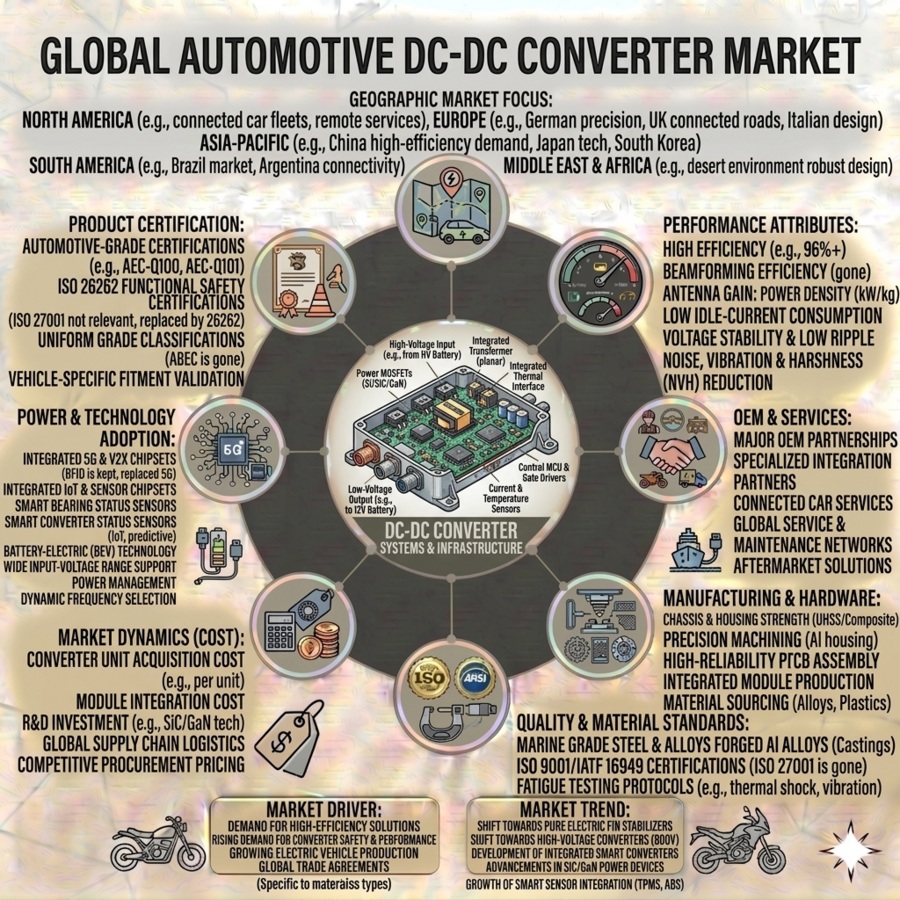
Automotive DC-DC Converter Market
The automotive DC-DC converter market is valued at USD 37.23 billion in 2025 and is projected to reach USD 106.67 billion by 2035, rising at a 29.6% CAGR.
NEWARK, DE, UNITED STATES, April 2, 2026 /EINPresswire.com/ -- As the global automotive industry undergoes a structural pivot from internal combustion to high-voltage electrification, the silent workhorses of the power electronics suite are seeing an unprecedented surge in valuation. According to the latest 2025-2026 strategic analysis, the Global Automotive DC-DC Converter Market is valued at USD 37.23 billion in 2025 and is projected to skyrocket to USD 106.67 billion by 2035, expanding at a massive CAGR of 29.6%.
This explosive growth represents more than USD 69.4 billion in new value added over the decade. The market’s trajectory is inextricably linked to the rising complexity of Electric Vehicle (EV) architectures, where the traditional alternator is being replaced by sophisticated multi-voltage power distribution units that manage everything from 800V battery packs to 12V infotainment systems.
The Architecture of Efficiency: BEVs and the 48V Bridge
The market is currently bifurcated between two massive technical shifts: the total electrification of the powertrain and the optimization of auxiliary loads. Battery Electric Vehicles (BEVs) currently command a dominant 58.4% market share. In these architectures, the DC-DC converter is a mission-critical component; without it, the high-voltage energy stored in the lithium-ion traction battery cannot be stepped down to power safety-critical systems like steering, braking, and Advanced Driver Assistance Systems (ADAS).
Simultaneously, the 15V–36V category remains the largest voltage domain by volume, holding a 46.7% share. This is largely due to the global rise of 48V mild-hybrid systems. These systems act as a cost-effective "bridge" for legacy platforms, allowing manufacturers to implement regenerative braking and electric torque assist without the expense of a full EV battery. The DC-DC converter serves as the essential interface in these dual-voltage vehicles, seamlessly balancing power between 48V and 12V circuits.
Get Access of Report Sample:
https://www.futuremarketinsights.com/reports/sample/rep-gb-15861
Technological Evolution: The 800V Shift and SiC Innovation
The industry is moving away from basic silicon-based converters toward wide-bandgap semiconductors. From 2030 to 2035, the market is expected to realize 81.1% of its decade-long growth as the industry standardizes 800V platforms.
• Silicon Carbide (SiC) and Gallium Nitride (GaN): These advanced materials allow converters to operate at 96% to 99% efficiency. By reducing energy loss during voltage transformation, these semiconductors directly extend an EV’s driving range and reduce the need for heavy, expensive cooling systems.
• AI-Managed Distribution: Intelligence is moving into the power module. Leading Tier-1 suppliers like Bosch and Continental are integrating AI-driven predictive load management. These "smart converters" can anticipate power surges from the climate control or infotainment units and adjust energy flow in real-time to preserve battery health.
• Thermal Management: As power density increases, heat becomes the primary enemy. Manufacturers are pivoting toward lightweight, compact designs with advanced liquid-cooling manifolds to fit the tight "frunk" and chassis spaces of modern EVs.
Regional Powerhouses: India and China Leading the Charge
The global automotive DC-DC converter market is characterized by exceptionally high growth rates across all major regions, led by India with a projected 30.5% CAGR fueled by massive FAME-II incentives and a rapid transition toward electric two-wheelers and public bus fleets. China follows closely at a 30.2% CAGR, leveraging its status as the world’s largest New Energy Vehicle (NEV) ecosystem and a highly mature domestic supply chain for Silicon Carbide (SiC) semiconductors. In the United States, a 29.8% CAGR is anticipated as Inflation Reduction Act (IRA) incentives accelerate the electrification of high-power pickup truck segments. South Korea and Japan show nearly identical trajectories at 29.7% and 29.5% CAGR respectively; South Korea benefits from its pioneering 800V E-GMP platforms, while Japan translates decades of hybrid expertise into high-reliability battery electric vehicle (BEV) architectures. Finally, the United Kingdom is expected to expand at a 29.4% CAGR, driven by strict 2030/2035 internal combustion engine bans that are forcing a surge in localized power electronics manufacturing.
In North America, the market is being shaped by the unique power demands of electric pickup trucks like the Ford F-150 Lightning and Tesla Cybertruck. These vehicles require high-power DC-DC converters (3kW to 7kW) to support work-site tools and vehicle-to-load (V2L) functions, creating a high-margin segment for specialized suppliers.
Competitive Landscape: The Masters of Power Electronics
The market is consolidating around a few global leaders who possess deep integration capabilities. Denso Corporation, Robert Bosch GmbH, and Toyota Industries currently lead the field. These companies are no longer just selling hardware; they are providing integrated "E-axle" and power management software suites.
Competition is intensifying not just on price, but on power density. The goal for engineers at firms like BorgWarner (Delphi) and Marelli is to create the smallest possible footprint that can handle the highest possible current. As wide-bandgap semiconductors reach 50% market penetration by 2035, the companies that control the SiC supply chain will likely dictate market pricing.
Frequently Asked Questions (FAQ)
1. Why can't an EV just use 12V for everything?
High-voltage batteries (400V+) are necessary to move the car efficiently and allow for fast charging. However, electronics like your radio, headlights, and sensors are designed for 12V or 48V. Using 400V for a lightbulb would melt it instantly; the DC-DC converter acts as the "transformer" that keeps these smaller systems safe.
2. What is the difference between an On-Board Charger (OBC) and a DC-DC converter?
An OBC converts AC power from your wall plug into DC power for the battery. A DC-DC converter takes the DC power already in the battery and changes its voltage to power the car's internal electronics.
3. Will the shift to 800V make DC-DC converters more expensive?
Initially, yes. 800V systems require more robust insulation and more expensive SiC semiconductors. However, because they are more efficient, they allow for smaller batteries and faster charging, which reduces the total cost of the vehicle for the consumer over time.
4. Do hybrids use the same DC-DC converters as pure EVs?
No. Hybrids often use smaller, lower-power converters (often in the 15V-36V range) because they still have an engine to help with some power needs. Pure BEVs require "Heavy Duty" converters because they have no other way to generate low-voltage power.
5. How long does a typical automotive DC-DC converter last?
Automotive-grade converters are designed for a 15-year or 150,000-mile lifespan. Because they have no moving parts, they are generally very reliable, but they are sensitive to extreme heat, which is why thermal management is so critical.
Browse More Industry Reports :
Automotive Torque Converter Market
https://www.futuremarketinsights.com/reports/automotive-torque-converter-market
Automotive Catalytic Converter Market
https://www.futuremarketinsights.com/reports/automotive-catalytic-converter-market
Automotive Three Way Catalytic Converter Market
https://www.futuremarketinsights.com/reports/automotive-three-way-catalytic-converter-market
Sudip Saha
Future Market Insights Inc.
+1 347-918-3531
email us here
Legal Disclaimer:
EIN Presswire provides this news content "as is" without warranty of any kind. We do not accept any responsibility or liability for the accuracy, content, images, videos, licenses, completeness, legality, or reliability of the information contained in this article. If you have any complaints or copyright issues related to this article, kindly contact the author above.
